
Advertisement
FTCE General Knowledge Mathematics
This Test Tutoring Video provides an answer and explanation for Question 10 from our Version 1 Practice Test for FTCE General Knowledge Mathematics. It is part of our Free FTCE General Knowledge Mathematics Prep Course, which also includes longer "Core Videos" that go further in-depth and teach all the content knowledge you need for success on the exam.
Question 10 (V1)
Aaron creates a stacked cake comprised of three cylindrical sections as pictured below, and plans to cover the top of each section with a different color icing.
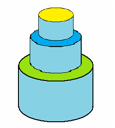
Each lower section is a total of two inches wider than the section above it. If the yellow top of the upper section has an area of 12.56 square inches, what is the approximate area of the green visible portion of the bottom section which he will need to cover with icing?
A. 13 square inches
B. 88 square inches
C. 49 square inches
D. 22 square inches
Answer & Explanation
Done watching this? Return to the course homepage to access your other free videos.
Return to Course HomepageAdvertisement
Video Transcript
Below is a full text transcript of our video above, which explains how to answer Question 10 from Version 1 of our FTCE General Knowledge Mathematics practice test.
- We're being asked to find the approximate area of the green top section of this multi-layered cake. And we're assuming, based on what they tell you in the question, that they're not covering the entire top of each layer with icing, but only the visible portion. So, what we're really doing here is solving for the area of a circle, but we're not given all the information we need.
We are given information about some of the circles, and we're gonna have to use the areas of some circles to find other parts of the circles, namely, their radii and their diameters, so that we can use that information to find the area of the circle we really want. First of all, let's recall that the area of a circle equals pi times the radius squared. And for our purposes on the test you can just substitute the number 3.14 whenever you see pi. Let's find the radius of the yellow top section.
So, remember, area equals pi r squared, and we're given the areas, so let's plug that in. 12.56 square inches equals pi, 3.14... Times the radius squared. So now we're gonna solve for the radius, r. So divide both sides by 3.14. Over here, they cancel out, over here, you get four when you divide. You can do that on your calculator.
And you get four equals the radius squared, and so then if you take the square root of both sides that cancels out with the squared, and the square root of four is two, so two equals the radius of the top portion.
So now, if you want to find the total area of the bottom portion of that cake, you can just say, "Okay, well, if the radius of "the top portion is two, then the diameter of "the top portion has to be double that, four." So if the diameter of this one is four, the diameter of the top of the blue section is six, and the diameter of the top of the green section is eight, and therefore we also know the radius of the blue circle top would be three, and the radius of the green circle top from here to here would be four.
Area equals pi, 3.14. 3.14 times the radius, four... Squared. We square four and get 16. 16 times 3.14, you can do this on the calculator, is going to be approximately 50.
So 50 square inches is the approximate area of the green section of that cake, however, they're only ask, the entire top of that green section, but they're only asking for the visible portion, so what we need to do is subtract the total area of the top of the blue cake from the green, and that's gonna give us what's left, just the visible portion. So now, let's use what we know, again, about the yellow cake to find the, what the area of the entire top of the blue cake would be.
So, if the diameter of the top of the blue cake is six, then we cut that in half, the radius of the top of the blue cake is three. So now we're talkin' about the entire top of the blue cake, area of the top of the blue cake is pi, 3.14, times the radius, three squared. We square three and get nine. 3.14 times nine, again, you can do this on your calculator if you want, comes out to approximately 28. So you subtract 28 from 50, and that's gonna give you 22.
22, answer choice D, 22 square inches is the visible portion of the green top of the cake. Be careful for answer traps like answer B. If you, instead of using the radius of each of the cakes, were to simply use the diameter, you would arrive at 88 square inches, so they'll put answer choices in there to catch you if you make simple mistakes that are quite easy to make.