
Advertisement
FTCE General Knowledge Mathematics
This Test Tutoring Video provides an answer and explanation for Question 12 from our Version 1 Practice Test for FTCE General Knowledge Mathematics. It is part of our Free FTCE General Knowledge Mathematics Prep Course, which also includes longer "Core Videos" that go further in-depth and teach all the content knowledge you need for success on the exam.
Question 12 (V1)
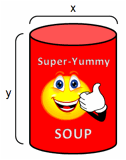
Super-Yummy Soup, Inc. wants to paint their entire soup can red, including the top and bottom. If the diameter of the lid (x) is 5 cm, and the height of the can (y) is 9 cm, what is the approximate total surface area that will need to be painted?
A. 97.3 cm2
B. 164 cm3
C. 154.2 cm2
D. 180.6 cm2
Answer & Explanation
Done watching this? Return to the course homepage to access your other free videos.
Return to Course HomepageAdvertisement
Video Transcript
Below is a full text transcript of our video above, which explains how to answer Question 12 from Version 1 of our FTCE General Knowledge Mathematics practice test.
- When you're looking for surface area, sometimes it can be helpful to break the three-dimensional figure down into its component two-dimensional parts. This way you can really use the formulas you already know for two-dimensional shapes in plane geometry in for the solid geometric figure. You don't really have to know any additional formulas as long as you break this figure down to its two-dimensional parts, so let's do that.
Let's imagine we take some heavy duty scissors and we cut the the top off this can. It's a circle, right. And then let's do the same thing to the bottom. It's another circle of exactly the same area. And then we take some heavy duty scissors, and we cut the side of this can, and we unroll it. What shape do we get? We get a rectangle. So we really have two circles and a rectangle, and we know how to find the area of a circle, and we know how to find the area of a rectangle.
So by using the formulas we already know, we can find the areas of each of these component parts and therefore find the entire surface area of this can. So let's label what we have here. The diameter of the lid is five centimeters, and the height of the can is nine centimeters. So in order to find the area of a circle, we just need its radius because the area of a circle equals pi times the radius squared. So the diameter goes all the way across.
The radius goes half of the way across, so the radius is always half the diameter, so 2.5 would be the radius. So let's plug that in. Area of the circle equals pi, which we can just write 3.14, times the radius, which is 2.5 squared. So we square 2.5, and we get 6.25. And then we multiply 6.25 on our calculator. 6.25 times 3.14, and we get 19.625. So the area of the circle equals 19.625.
and if we know the area of this circle is 19.625, we know that the area of this circle is also 19.625, so let's double that. 19.625 times two. We will do that again on our calculator, and it comes out to 39.25. So we now know the area of both of the circles. The only remaining part of this can surface that we need to find is the side. We know the height of this rectangle, but we don't know the length of it, and we need to know both the length and the width in order to figure out its total area.
So we've got one of those dimensions but not the other. How can we find this dimension of the rectangle? Well, when this was still assembled as a can, this side wrapped all the way around the top of the can, so the distance around the top of the can is the same as the length of this side. What do we call the distance around the distance the top of the can? The circumference, so we're really solving for the circumference of the circle to find the length of this rectangle.
Circumference of a circle equals pi times the diameter, so the diameter we know is five, and pi is 3.14. So 3.14 times the diameter five, and when we multiply 3.14 times five, on our calculator we get 15.7, so 15.7 is the length of this side of the rectangle, and, remember, the formula for the area of a rectangle is just length times width. Area of a rectangle equals length times width. The length, 15.7, and we'll call the width nine. 0.7 times nine.
Again, you'll use your calculator, and you'll get 141.3. So we now know the area of each of the circles, and we know the area of the rectangle. We just add those up, and we get the total surface area of the shape. So 141.3 plus the area of both of the circles put together, 39.25, equals 180.55. And, remember, it says, "What's the approximate total surface area?" so they've rounded the answer choices off to the nearest tenth.
When we have a five, we round up, so 180.55 rounds up to 180.6, and that's answer choice D.