
Advertisement
FTCE General Knowledge Mathematics
This Test Tutoring Video provides an answer and explanation for Question 22 from our Version 1 Practice Test for FTCE General Knowledge Mathematics. It is part of our Free FTCE General Knowledge Mathematics Prep Course, which also includes longer "Core Videos" that go further in-depth and teach all the content knowledge you need for success on the exam.
Question 22 (V1)
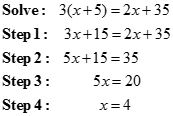
Which is the first incorrect step in the solution shown below?
A. Step 1
B. Step 2
C. Step 3
D. Step 4
Answer & Explanation
Done watching this? Return to the course homepage to access your other free videos.
Return to Course HomepageAdvertisement
Video Transcript
Below is a full text transcript of our video above, which explains how to answer Question 22 from Version 1 of our FTCE General Knowledge Mathematics practice test.
1 - What is the first incorrect step in the solution show below? So here's an algebra problem where we're getting someone's solving it step by step, and like a teacher would in a math class, we have to look through this student's work and see where the mistake was made so that we can understand what part of this process of, in this case, solving a single variable equation in algebra, is the mistake being made. What step are they not executing correctly? So, let's look step by step.
So, we're starting with the equation three times x plus five. That x plus five in parenthesis, equals two x plus 35. So if we think about how to solve a multiple step single variable algebra problem the first thing that should be going through our head in this recipe or the steps involved would be please excuse my dear Aunt Sally, or PEMDAS, our order of operations. That P standing for parenthesis. So inside the parenthesis, x plus five, there are no like terms to be combined.
However outside the parenthesis we have that three and any time we have a number on the outside of a parenthesis, it tells us that we can distribute. So that is an example of multiplication. So P, no parenthesis work, no exponents here. But M, multiplication, the distributing, that's where we would start with our order of operations. So we multiply out that three and that gets us what we have here in step one. They have multiplied out the three, distributed it out.
Three x, and three times five is positive 15. So the left-hand side has been distributed correctly. The right-hand side stays the same for right now. Then we look from step one to step two what's happening. They are dealing with the x's because we can see in step two now they have five x on the left rather than the three x that was there in the previous step. So clearly they are getting to the step of isolating the variable using balancing.
Balancing mean whatever we do to one side of the equation we must also do to the other. But here is where we see our mistake. They have to get five x on the left added two x. But what's the problem with that? If I added two x to both sides I would get five x plus 15 on the left but I would have four x plus 35 on the right. And they've eliminated the x's altogether on the right there so they didn't do that part correctly.
So the mistake made here is that instead of adding two x to both sides, we should be subtracting two x from both sides as part of that balancing process. That would get us to x plus 15 equals 35 and we can go from there. But because they've added two x to both sides in the balancing step two is where we see our mistake. And in this case that's what they're looking for so B, step two, is our correct answer.